Last Tuesday I needed to update three docs in our internal knowledge base. I did not open the docs tool. I opened Claude. I asked it to grab the latest from a Linear ticket, summarise the changes, find the relevant pages, and update them. It did all of that, through MCP, while I made coffee. The browser tab for the actual product never got opened.
This is not unusual anymore. It is what a normal Tuesday looks like now. And it should be quietly terrifying for anyone building a SaaS product that still treats the UI as the main event.
The numbers say the UI lost the majority
Let's start with something uncomfortable. According to Imperva's 2026 Bad Bot Report, automated traffic now accounts for more than 53 percent of all web traffic, the first time in a decade that humans are the minority on the internet. Inside that automated slice, AI agentic traffic grew nearly 8,000 percent in 2025. The fastest-growing thing on the web is no longer a person clicking around. It is an agent doing a job on someone's behalf.
On the protocol side, the story is even sharper. Anthropic's MCP, which barely existed at the start of 2025, is now in production at 78 percent of enterprise AI teams as of Q1 2026, up from 31 percent a year earlier. The public MCP server registry went from about 1,200 servers in Q1 2025 to over 9,400 in April 2026. In December 2025, Anthropic donated the protocol to the new Agentic AI Foundation under the Linux Foundation, with OpenAI, Google, Microsoft, and AWS all on board. That was the moment MCP stopped being an Anthropic thing and started being the integration layer.
And on top of that, Gartner is now predicting that 40 percent of enterprise applications will ship with task-specific AI agents by the end of 2026, up from less than 5 percent today.
Read those numbers together. The pipe through which your product gets used is being rebuilt under your feet, and a huge portion of the new traffic will never see a button.
Most products are still UI-first under the hood
I notice this every time I look at a new SaaS tool.
The UI is gorgeous. The API is an afterthought. There is a /docs page with twelve endpoints out of the forty the UI uses. There is no MCP server. The CLI, if one exists, is a community side project that gets abandoned every six months. The onboarding flow assumes you are a human clicking through a wizard, because the product was conceived as something humans would log into.
That model worked for fifteen years. It is starting to fail in 2026, and it is going to fail harder every quarter from here.
Here is what I keep watching happen. A team adopts a new tool. They use the UI for the first few weeks. Then someone in the team plugs Claude or ChatGPT into their workflow. Suddenly the question is not "how do I open the UI and update this thing". The question is "can my agent do this for me". If the answer is no, that tool's usage starts to flatline. Not because the UI got worse. Because the entry point moved.
Bot traffic targeting APIs jumped to 27 percent of all bot traffic in 2025, according to the same Imperva report. That number is going to climb every year. Every agentic workflow is a stack of API calls, and every product that does not expose those calls is going to fall out of the workflow.
What "works without your UI" actually means
This is more than just "have an API." Most products have an API. Most APIs are also bad.
The product that works without its UI passes a much harder bar. I think there are roughly four tests.
- Every meaningful action in the UI is callable from the API. No "set this up via the dashboard" features. No "this can only be configured by an admin in the UI" boxes. If a human can do it, an agent can do it.
- There is an MCP server, and it is first-party. Not a community project. Not a wrapper somebody built last weekend. A real, owned, versioned MCP server that exposes the same surface as the API in a way agents can reason about.
- There is a CLI with parity. Because CLIs are how engineers script things, and because CLIs are also how a lot of agentic frameworks end up calling tools when MCP is not available.
- Authentication works for non-humans. Service accounts, scoped tokens, OAuth flows that an agent can complete on a user's behalf. Not "click this magic link in your email," because the agent does not have an email client.
If your product fails any of these, you have built a UI with a backend, not a product. The difference will matter more and more.
We had to make this call at Rasepi, and it was not subtle
I will be honest, this is why we built Rasepi the way we did, and it was a real architectural decision, not a marketing line.
When we sketched the product in early 2025, the obvious thing to build was another Confluence-shaped UI. A pretty editor, a pretty reader, a search bar on top. We almost did. What stopped us was watching how teams were already using Claude, GPT, and similar agents to read and write their internal docs without ever opening the existing tool. The UI was not the bottleneck. The lack of programmatic surface area was.
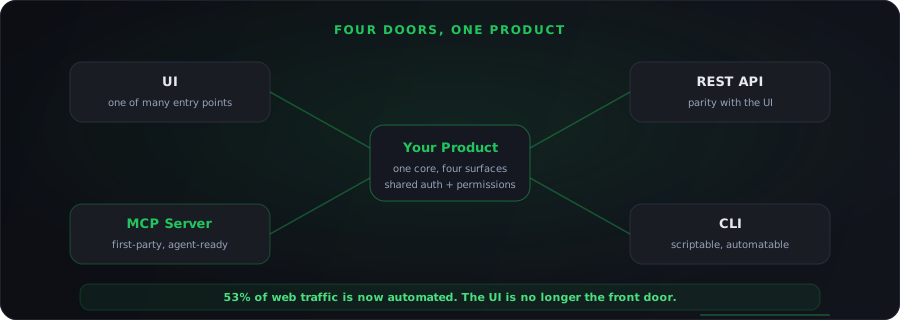
So Rasepi was designed API-first, with the UI built on top of the same surface that any agent or script can hit. The MCP server, the REST API, and the CLI all share the same authentication, the same permission model, and the same content layer. The UI is just one of the consumers. We test the product by writing scripts against it, not by clicking through it.
That has consequences for what we build, in good and slightly painful ways. Every new feature has to ship with API parity. We cannot just "add a button" and call it done. The upside is that when a customer plugs Claude into their Rasepi instance, everything works. There is no "ah, that feature is UI-only, sorry."
What this means if you are building something right now
A few things, if I had to summarise the practical takeaway.
Stop measuring usage by UI activity alone. Measure your API and MCP traffic separately, and track them as growth metrics, not as ops noise. If your dashboard usage is flat but your API traffic is doubling, that is not a problem. That is the future arriving on schedule.
Build a first-party MCP server before the community builds a bad one for you. The 9,400 servers in the public registry are not all good. Most of them are leaky, half-implemented, and unmaintained, and your users will judge your product by the quality of that integration whether or not you wrote it.
And stop treating the API as the cheap version of your product. In a year, for a lot of customers, it is your product.
The companies that win in 2026 are the ones whose users can do everything through the API, the CLI, the MCP server, or the UI, and never feel like they picked the wrong door.
The UI is not going away. Humans will keep using it for the parts of the work that benefit from a visual surface, and that is fine. But it is no longer the front door. It is one door among several, and the other doors are growing faster than the front one.
If your product cannot stand up when the UI is closed, that is the bug to fix first.