There is a reason people say "let's talk it through" when something is complex.
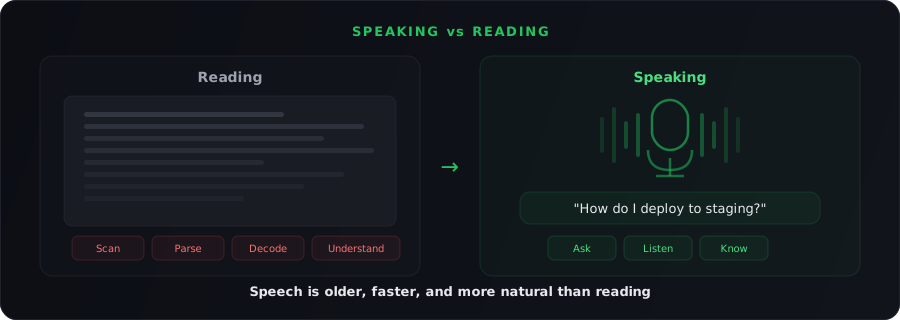
When we are trying to understand a new idea, solve a problem, or recall a process under pressure, conversation often feels easier than reading. Not because reading is bad. Reading is one of the most powerful tools humans have ever developed. But reading is a learned skill layered on top of something much older: speech.
We are talkers long before we are readers.
That matters more than people realise, especially now that more of the world's knowledge lives inside documents, wikis, PDFs, and long internal pages that nobody wants to open unless they absolutely have to.
Reading is learned. Conversation is native.
Human beings spoke for a very long time before they wrote anything down. Children learn to understand spoken language naturally. Reading takes explicit instruction, repetition, and years of practice.
Even for highly literate adults, reading is still a more deliberate act than listening or speaking. It asks for visual focus, continuous attention, working memory, and interpretation of structure on the page. You are decoding symbols, parsing sentences, building context, and deciding what matters.
Conversation works differently. When information is delivered in a spoken, interactive form, the brain gets a different experience:
- It feels sequential rather than visually overwhelming
- It provides immediate feedback and clarification
- It reduces the need to scan and filter large blocks of text
- It mirrors how people already ask for help in real life
That last point matters a lot. Under uncertainty, most people do not instinctively want to read 1,500 words. They want to ask: "What do I do next?"
Talking lowers cognitive friction
A document is static. It contains everything at once.
That sounds useful, and often it is. But it also creates friction. A page full of headings, callouts, links, notes, examples, and edge cases forces the reader to decide what to ignore. That's cognitively expensive.
When you talk to an information system, you usually get the opposite experience: relevance first, detail second.
You ask one question. You get one answer. Then you ask a follow-up.
That interaction pattern reduces mental overhead in a few important ways:
1. It narrows the problem space
A full document presents the whole landscape. A conversation presents the next useful step.
When someone asks, "How do I onboard a new engineer?" they usually do not want the entire handbook immediately. They want orientation. Conversation lets them begin small and expand only when needed.
2. It preserves working memory
Reading requires you to hold multiple things in your head while looking for the relevant part. Spoken or conversational interaction externalises that effort. The system does more of the filtering for you.
3. It feels socially familiar
Humans are deeply adapted to back-and-forth exchange. We ask. Someone answers. We refine. They clarify. That loop is one of the oldest forms of learning we have.
Even when the "someone" is a system, the structure still feels natural.
Reading is not passive. That's exactly the point.
One reason talking can feel easier is that reading is not as effortless as people assume. Skilled readers make it look effortless, but the process is highly active.
To read well, you have to:
- identify structure
- infer importance
- resolve ambiguity
- keep context in memory
- connect one section to another
- decide when to skim and when to slow down
That is real cognitive work.
In many situations, that work is worthwhile. Deep reading helps with nuance, precision, and long-form understanding. But in other situations, especially when someone is tired, stressed, overloaded, or just trying to get unstuck, talking is often the mentally lighter option.
This is especially true in the workplace, where people are usually not approaching documentation in ideal conditions. They are:
- mid-task
- interrupted
- context-switching
- trying to solve something quickly
- often already slightly frustrated
In that state, conversational access to information can feel dramatically better than page-first access.
Speaking changes the relationship with information
There is also an emotional dimension here.
Documents can feel formal and distant. They imply: read all of this, understand it correctly, and do not miss anything important. That can be useful for reference material, but it can also create hesitation.
Conversation feels permissive. You can be vague. You can ask badly. You can admit confusion. You can say, "I don't really know what I'm looking for, but I need the thing about access requests."
That matters because people often avoid documentation not because they dislike information, but because they dislike the effort and uncertainty involved in finding the right part of it.
Talking reduces that barrier.
Why this matters now
For a long time, documents had to be read because there was no practical alternative. Search helped people find pages, but it did not change the interaction model. You still had to open the page, scan it, and extract what you needed.
That is changing.
As interfaces become more conversational, people are increasingly expecting information to respond rather than simply exist. They want to ask for what they need in plain language and receive something shaped to the moment.
This does not make reading obsolete. It changes its role.
Reading becomes the deep layer. Conversation becomes the access layer.
The best systems will support both:
- talk when you need orientation or speed
- read when you need depth, verification, or full context
The risk of oversimplifying
There is one important caveat: talking to information only feels better if the answers are reliable.
If a conversational interface gives partial, misleading, or overly confident answers, the experience becomes worse than reading because it removes the user's ability to inspect the source material directly.
So the future is not "replace all documents with voice." The future is giving people a more human way to access documents without losing the depth and precision that written knowledge provides.
That balance matters. Conversation is easier, but documents still carry the durable structure, detail, and accountability that organisations need.
A more human interface to knowledge
The deeper point is simple: people do not naturally think in pages. They think in questions, stories, fragments, and dialogue.
We ask:
- What does this mean?
- What do I do first?
- What's the important part?
- Can you explain that differently?
- What changed?
Those are conversational moves, not reading moves.
So when talking to information feels mentally easier than reading it, that is not a sign of intellectual laziness. It is usually a sign that the interface matches the way the brain prefers to approach uncertainty.
Reading remains essential. But as an entry point to knowledge, conversation often feels better because it is closer to what we are by nature.
We are not readers first. We are talkers first. The most intuitive knowledge systems will remember that.